How to Write AI Song Prompts That Produce Better Music
Learn a repeatable AI song prompt workflow for lyrics, mood, structure, style tags, vocals, and commercial-ready song drafts.
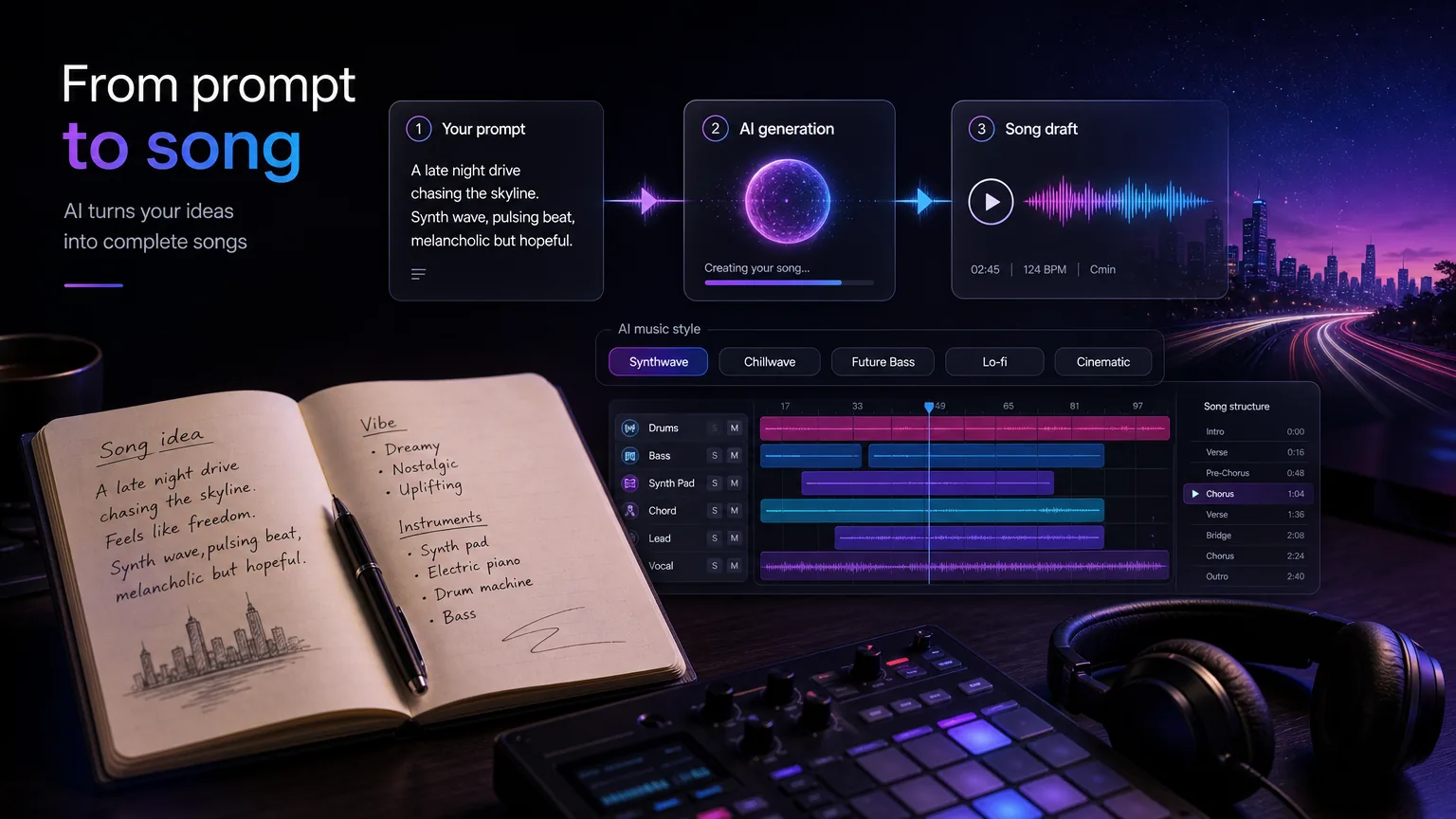
Good AI music starts with a clear creative brief. This guide shows how to turn a rough idea into a prompt that gives the model style, structure, vocal direction, and quality boundaries without overloading it.
Before you start
State the song goal before the genre so the model understands the use case.
Separate lyrics, structure, style tags, voice direction, and negative constraints.
Use one primary emotion and two supporting sonic references instead of piling on style tags.
Save your best prompt variants and reuse them as templates for future songs.
Practical workflow
Use the guide as a repeatable production pass
This guide is organized around the same steps a creator needs before opening the matching tool: define the input, control the model, review the result, then change one variable at a time.
Start with the job your song needs to do
Use a five-part prompt structure
Give style references without asking for imitation
Add negative constraints only when they protect the result
Field-tested prompt patterns
Short video hook
Reels, Shorts, product clips
Create a 45-second upbeat [genre] song for [audience] watching [scene]. Use [vocal tone], a fast hook within 8 seconds, clear chorus wording, [instrument palette], and no long spoken intro.
Full demo brief
Two-minute creator demo
Write and arrange a [mood] [genre] song about [story]. Structure: verse, pre-chorus, chorus, verse, chorus, bridge, final chorus. Voice: [range and attitude]. Keep the chorus simple, memorable, and clean.
Revision pass
Improving a weak first draft
Keep the same theme and chorus idea, but regenerate with clearer lead vocals, tighter drums, less reverb, a stronger chorus lift, and no sudden genre changes.
Quality bar
Do not approve the draft until it passes these checks
Brief clarity
A stranger should understand the listener, scene, mood, and output length in one read.
Style control
The prompt names musical traits instead of asking to copy an artist or voice.
Chorus priority
The most important line or emotional idea is reserved for the hook.
Negative constraints
Every negative instruction removes a real failure mode instead of adding preference noise.
Repeatability
The prompt can be saved as a reusable brief by replacing topic, audience, and style fields.
Start with the job your song needs to do
Most weak prompts begin with a genre and stop there. A stronger AI song prompt starts with the job of the track: a podcast intro, a birthday surprise, a game loop, a product launch reel, or a full vocal demo. The use case changes the arrangement, length, energy, and mix density.
Write one sentence that explains the listener, the moment, and the action you want after they hear the song. That sentence becomes the anchor for every later choice. If the song is for a short video, request a faster hook. If it is for a personal gift, ask for clearer vocals and a warmer chorus.
Bad: make a pop song about summer.
Better: create a 45-second upbeat pop hook for a travel reel about two friends leaving the city at sunrise.
Best: add the desired vocal tone, structure, tempo range, and what to avoid.
Next step: text to song workflow — Use this when the prompt starts from a raw idea instead of finished lyrics.
Use a five-part prompt structure
A reliable prompt has five parts: concept, lyrical angle, musical style, vocal direction, and output constraints. This format gives the model enough information to make decisions while keeping the request readable.
The concept explains the story. The lyrical angle defines point of view. The style guides instrumentation and rhythm. The vocal direction explains who is singing and how they should feel. Output constraints define duration, clean language, instrumental sections, or commercial-safe tone.
Concept: what happens in the song.
Lyrical angle: who speaks and what they feel.
Style: genre, mood, tempo, instruments.
Voice: gender, tone, range, intensity.
Constraints: duration, explicit language, intro length, ending.
Next step: lyrics to song arrangement — Use this when the words are finished and the missing piece is production direction.
Give style references without asking for imitation
For copyright-safe creation, describe musical qualities instead of asking for a living artist clone. Use terms like glossy synth pop, acoustic folk warmth, cinematic trap drums, or intimate bedroom vocals. This keeps the prompt useful while avoiding risky voice or artist imitation.
If you like a famous sound, translate it into objective traits: tempo, drum feel, instrumentation, vocal energy, arrangement density, and emotional color. This gives the generator creative direction without pushing it toward a copy.
Next step: AI music generator — Move the cleaned prompt into generation after the brief passes the checklist.
Add negative constraints only when they protect the result
Negative constraints help when they remove common failure modes. For example: no long spoken intro, avoid distorted vocals, no sudden genre switch, keep the chorus easy to sing, or avoid overly busy percussion. Too many negatives can make the prompt harder to follow.
The best rule is simple: include a constraint only if you would reject the track without it. If the detail is just personal preference, save it for the next iteration after hearing the first draft.
Next step: commercial rights for AI music — Check rights before using prompt-generated music in campaigns or client work.
Turn prompts into reusable templates
Once a prompt creates a useful song, save the structure rather than the exact words. Replace the topic, audience, and style fields while keeping the successful layout. This turns prompt writing into a repeatable production workflow.
A small template library helps teams keep brand sound consistent across ads, intros, social videos, and seasonal campaigns. It also makes future A/B testing easier because you can change one variable at a time.
Next step: download the 60-prompt CSV — Use the dated CSV as a reusable prompt library with explicit fields and creator-focused use cases.
Download the 60-prompt dataset
Version 2026-08-30 contains 60 original prompts covering vocal songs, instrumentals, creator videos, podcasts, games, celebrations, wellness, brand work, and major music styles.
Method: every prompt was written for a distinct use case and reviewed against the same controllable fields, so you can compare or revise one production decision at a time.
Fields: id, use_case, genre, mood, instruments, tempo_bpm, vocal_direction, structure, and prompt.
Coverage: practical creator scenarios plus pop, rock, electronic, acoustic, cinematic, regional, and ambient directions.
Safety: no named-artist imitation, copied lyrics, official marks, or promised outcomes.
How to use: choose one row, replace the scene and audience, then change only one musical variable per iteration.
Frequently asked questions
How long should an AI song prompt be?
For most songs, 120 to 250 words is enough. It should include concept, style, vocal tone, structure, and constraints without becoming a full production document.
Should I include lyrics inside the prompt?
If you already wrote lyrics, paste them in the lyrics field and use the prompt for arrangement direction. If not, describe the theme and ask the generator to write lyrics.
Do more style tags improve the result?
No. A few precise descriptors work better than a long style list. Clear genre, mood, vocal, and structure notes produce more consistent music.