Song Lyrics Ideas: Turn Topics, Moods, and Hooks Into Better Lyrics
Find song lyrics ideas from real scenes, moods, memories, hook banks, and AI lyric prompts before turning them into singable drafts.
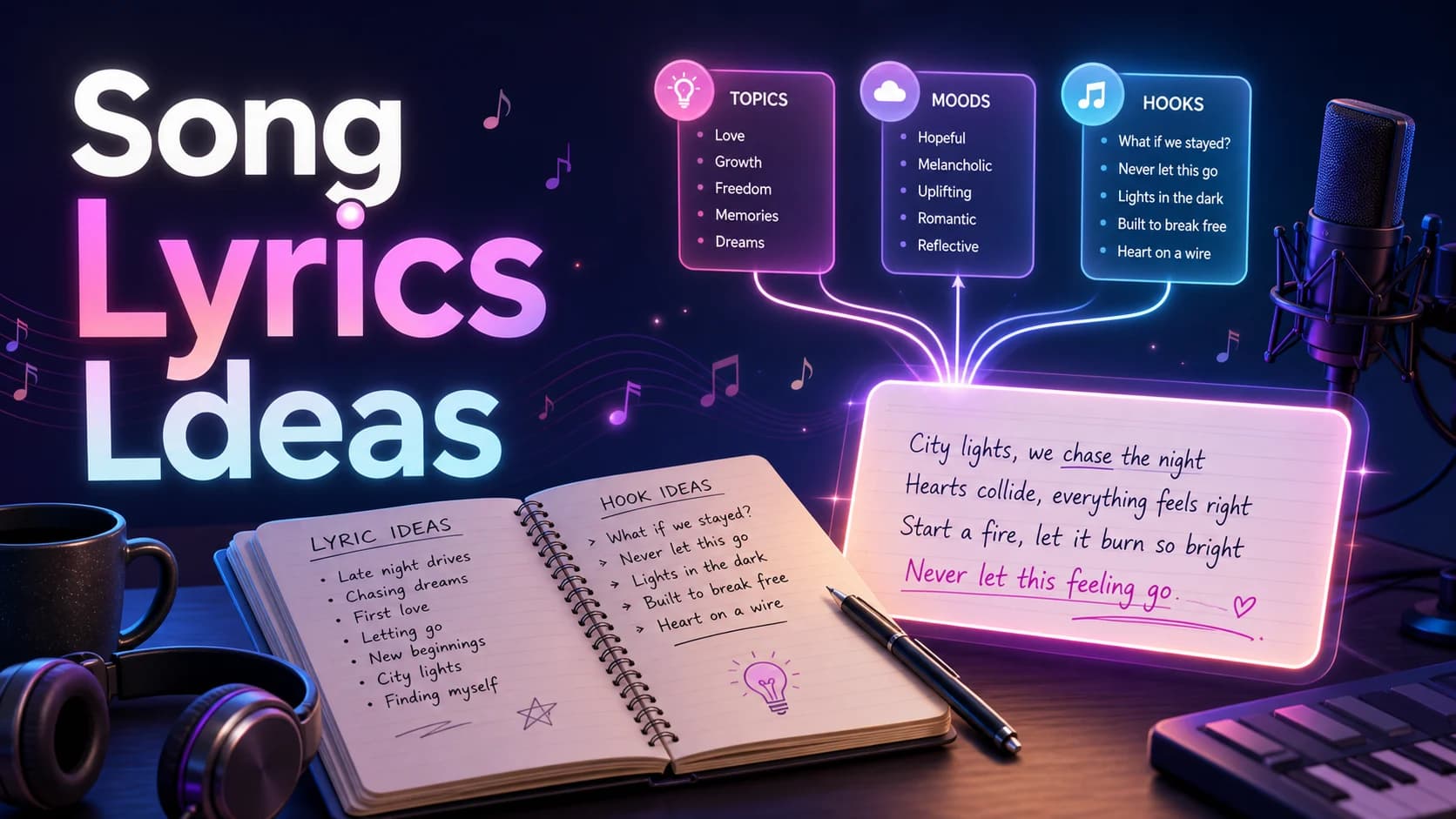
Strong lyrics usually begin with a specific situation, not a blank page. This guide shows how to turn moods, memories, objects, and hook phrases into lyric ideas that are easier to refine with AI.
Before you start
Start from a real listener moment instead of a broad topic.
Build hook banks before asking for full verses.
Use concrete objects, places, and memories to make lyrics less generic.
Move strong ideas into an AI lyrics workflow only after the angle is clear.
Practical workflow
Use the guide as a repeatable production pass
This guide is organized around the same steps a creator needs before opening the matching tool: define the input, control the model, review the result, then change one variable at a time.
Start with a real song situation
Turn moods into lyric angles
Build a hook bank before writing the full song
Use objects, places, and memories
Field-tested prompt patterns
Hook idea bank
Before drafting a chorus
Generate 12 short hook ideas for a [genre] song about [specific scene]. Mood: [mood]. Point of view: [speaker]. Use concrete images from [place or memory], keep each hook under 10 words, and avoid generic phrases.
Verse angle options
Choosing a lyric direction
Give me five lyric angles for a song about [topic]. Each angle should include speaker, listener, emotional turn, one object image, and a possible chorus title.
Singability rewrite
Idea is strong but crowded
Rewrite these lyric ideas into shorter, singable lines. Preserve the main image and emotional meaning, improve vowel endings, and keep the chorus phrase easy to repeat.
Quality bar
Do not approve the draft until it passes these checks
Specific scene
The lyric idea includes a place, moment, or action instead of only a broad emotion.
Clear speaker
The listener can tell who is singing and who they are addressing.
Hook length
The main phrase is short enough to repeat without rushing.
Concrete image
At least one object, memory, or sensory detail anchors the song.
Workflow fit
The idea is ready for lyric drafting before moving into arrangement or generation.
Start with a real song situation
A topic like heartbreak, summer, or ambition is too large to become a useful lyric by itself. A stronger lyric idea begins with a scene: a late train ride after an argument, a birthday message recorded at midnight, or a voice memo made before leaving home.
The scene gives the lyric a speaker, a listener, and a reason to exist. Once those three pieces are clear, an AI lyrics generator can offer useful lines instead of generic emotional filler.
Name the speaker and the person they are addressing.
Describe the place where the feeling happens.
Write the emotional turn the song should reach by the chorus.
Next step: AI lyrics generator — Turn the strongest idea into hooks, verses, rhymes, or lyric rewrites.
Turn moods into lyric angles
Mood words help, but they need a direction. Hopeful can mean recovering after a breakup, celebrating a small win, or waiting for someone to come home. Nostalgic can mean warm, regretful, funny, or bittersweet.
Before generating lyrics, pair each mood with a point of view. Ask whether the singer is confessing, remembering, apologizing, inviting, teasing, or letting go. That verb makes the lyric more active.
Next step: AI lyrics generator guide — Use AI to refine lyrics without losing your own voice.
Build a hook bank before writing the full song
A hook bank is a short list of possible chorus lines, title phrases, repeated images, and rhythmic slogans. It is faster to test ten hooks than to regenerate ten full songs. The best hook often reveals the rest of the lyric structure.
Keep hook candidates short enough to repeat. If a phrase cannot be sung twice without feeling crowded, it may work better as a verse detail than a chorus anchor.
Write five possible titles.
Write five chorus openers.
Write three repeated phrases a listener could remember after one play.
Next step: lyrics to song arrangement guide — Move finished lyrics into arrangement and vocal direction.
Use objects, places, and memories
Concrete nouns make lyric ideas feel personal. A cracked phone screen, a blue hoodie, a kitchen light, or a bus stop can carry more emotion than another line about missing someone. These details give AI something specific to develop.
Use one or two details per section. Too many objects can make the lyric feel like a list. The goal is to choose the detail that best explains the feeling without spelling everything out.
Next step: AI song prompt guide — Add musical style and structure after the lyric idea is clear.
Move strong ideas into a lyrics workflow
Once the title, mood, point of view, and key image are clear, move into drafting. Use the AI lyrics generator for hook options, verse expansion, rhyme alternatives, or tone revision instead of asking it to solve every creative choice at once.
After the lyric reads well, send it into a lyrics-to-song workflow with section labels and vocal notes. This keeps the writing stage separate from arrangement decisions, which makes the final song easier to control.
Frequently asked questions
How do I get ideas for song lyrics?
Start with a specific scene, speaker, listener, and emotional turn. Then collect hook phrases, concrete images, and mood words before writing full verses.
Can AI help with lyric ideas?
Yes. AI is most useful when you give it a clear angle, mood, and image, then ask for hook options, verse directions, or rewrites rather than a complete generic song.
What makes a lyric idea singable?
A singable idea usually has a short hook phrase, clear vowels, focused emotion, and line lengths that leave room for breath and melody.